 smartware

English
- 中文
- English

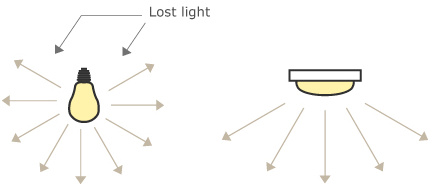
Conventional lightsources cast a lot of light backwards, which may be lost in the optics design
of a luminaire. The LED, on the other hand, emits all light in one direction.
The performance of LED is often measured in terms of lumens per watt or efficacy. With
luminaires with fluorescent tubes, the efficiency is explained using the LOR or Light Output Ratio.
The LOR would measure how efficient the optics are. For these luminaires, the installed power in
watt is often used as a measure on the luminaire's light output. LED luminaires, however, usually
use the rated luminaire lumen to determine the luminaire's light output.
The rated lumen value from an LED module may give an inaccurate picture of how many lumen
you actually get from the luminaire. When documenting an LED luminaire, Luxo always lists the
lumen value out of the luminaire, the so called rated lumen, luminaire. When you compare this
lumen output with a T5 luminaire you must take the rated lumen from the T5 lamps and multiply
with the Light Output Ratio (LOR) of the luminaire (see figure).
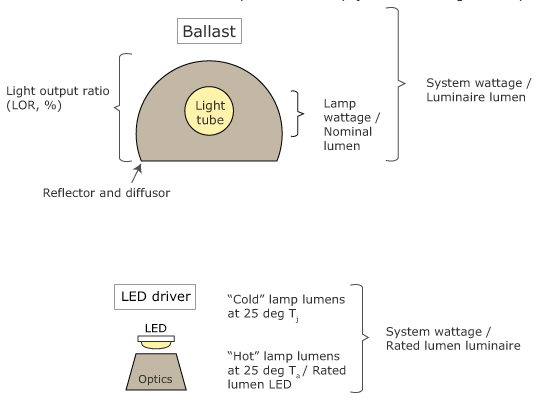
One should pay special attention to the difference between rated lumen, luminaire and rated
lumen, lamp, which is measured on the LED module.
Previously, LED manufacturers listed the lumen output at a junction temperature of 25 degrees,
or so-called cold lumens. The junction temperature is measured inside the diode itself.
Today, a more common denomination is to use hot lumens, i.e. lumens measured at an ambient
temperature of 25 degrees, which correspond to a much higher junction temperature.
